Telegram Forensic Analysis: What Investigators Need to Know

Telegram has experienced significant global user growth, supported by its simple registration process, cross-border accessibility, and privacy-oriented design. The platform enables users to communicate with a high level of anonymity, without mandatory identity verification or geographic restrictions.

While these features benefit legitimate users, they have also made Telegram a frequent choice for illicit and gray-market activities, including fraud coordination and underground transactions. As a result, Telegram analysis and the forensic analysis of Telegram have become essential components of modern digital investigations, requiring investigators to understand how the platform’s design influences evidence availability and acquisition.

CDN Forensics: How to Reveal the Real IP Address Behind Modern Content Delivery Networks

Content Delivery Networks (CDNs) are a core part of modern internet infrastructure, enabling fast, stable, and secure online services. A CDN is a distributed network of servers designed to deliver web content to users more efficiently based on their geographic location.

At the same time, reports from major CDN providers such as Cloudflare and Akamai, along with public threat intelligence and law enforcement investigations, confirm that CDNs are increasingly abused for phishing, malware distribution, and command-and-control activity. From a CDN forensics perspective, understanding this abuse does not weaken the value of CDN technology—it strengthens risk awareness and investigative capability.

Bitcoin Forensics and Cryptocurrency Forensics: A Beginner’s Guide to Blockchain Investigations

In October 2025, the U.S. Department of Justice announced an indictment against Chen Zhi, chairman of Cambodia’s Prince Group, alleging his involvement in operating large-scale forced-labor scam compounds that targeted victims across multiple countries.

A significant element of the case involves the use of cryptocurrency as a financial infrastructure for the network’s global operations. Prosecutors identified digital asset wallets were used to disguise the origin of funds and move proceeds across borders outside traditional banking oversight.

This case has drawn international attention not only for its human-trafficking and organized-crime dimensions, but also for the central role of cryptocurrency in enabling, accelerating, and concealing large-scale criminal revenue streams.

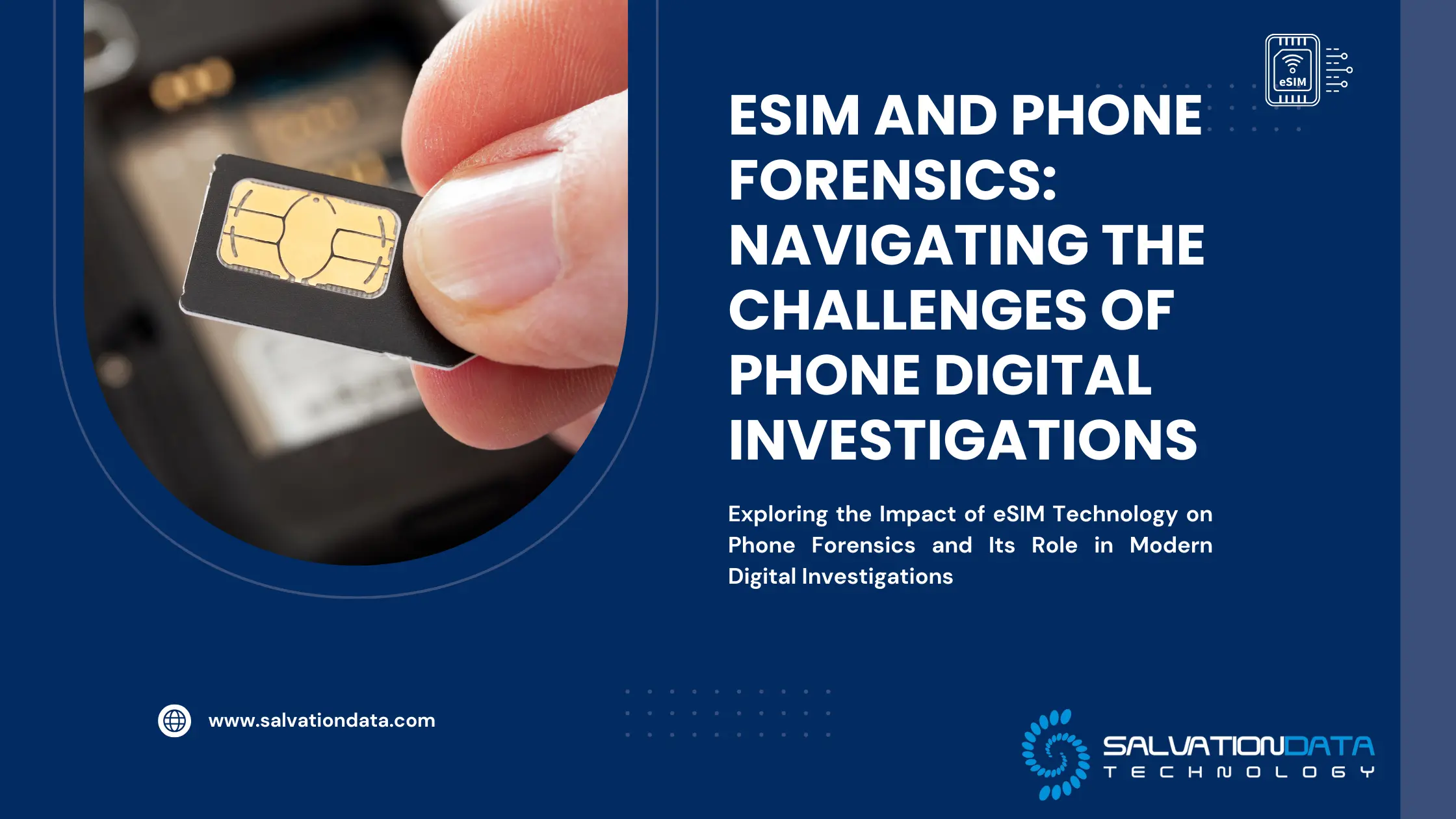
eSIM and Phone Forensics: Navigating the Challenges of Phone Digital Investigations

The rise of eSIM technology has revolutionized mobile connectivity, offering a more flexible and efficient alternative to traditional SIM cards. With eSIM embedded directly in devices, users can switch carriers digitally, without needing a physical card. This technology is particularly prominent in modern smartphones, such as the eSIM card iPhone series.

However, this advancement introduces new challenges in phone forensics. While SIM card forensics has traditionally been crucial for extracting data like call logs and messages, the shift to eSIM means that forensic experts must adapt their methods.

【Case Study】VIP3.0 – Advanced Video Detection & Log Analysis for Faster, Smarter Investigations

In digital forensics, the integrity and timeliness of video evidence are crucial. However, with the increasing volume of video data, traditional methods are no longer sufficient to efficiently handle the complexities of video analysis. VIP 3.0, an advanced video forensics tool, leverages intelligent missing video detection and log analysis to help investigators quickly pinpoint critical information and uncover the truth. This case study will delve into the performance of VIP 3.0 in real-world applications, highlighting how it accelerates investigations and enhances accuracy.

What is Fuzzy Hashing?

Hash functions are one of the cornerstones of modern computing. They transform data into fixed-length strings of characters, making it easy to verify integrity, secure information through encryption, and ensure consistency in digital forensics. Investigators and cybersecurity experts rely on cryptographic hashes like MD5 or SHA-1 to confirm whether a file has been altered—even the smallest change produces a completely different hash value.

But here’s the challenge: in real-world investigations, files are rarely identical. Malware samples often appear in multiple slightly modified versions, and digital evidence may be fragmented or partially corrupted. In these scenarios, traditional hashing falls short because it only works with exact matches.

This is where the question arises: what is fuzzy hashing, and why do we need it? Unlike conventional hashing methods that demand perfect equality, fuzzy hashing provides a way to detect similarities between data. It fills the critical gap when investigators need to identify files that are not exactly the same but still closely related—a capability that has become indispensable in modern digital forensics and cybersecurity.

Windows Shellbags Explained: What They Are and How They Help in Digital Forensics

Digital forensics relies heavily on uncovering hidden traces of user activity to drive investigations. One often-overlooked source of such evidence is Shellbags—artifacts stored within the Windows operating system that track a user’s folder access history and settings. Understanding what Shellbags are and how they work can give forensic investigators crucial insights into past activities, even when files have been deleted or altered.

This blog will explore Windows Shellbags, their role in forensic investigations, and how analyzing them can help uncover critical digital evidence that might otherwise remain undetected.

Amcache vs Shimcache: Understanding the Key Differences in Digital Forensics

When investigating Windows systems, two artifacts often stand out to forensic analysts: Amcache and Shimcache. Both provide valuable insights into program execution history, yet they capture and store data in different ways. Understanding the distinctions between Amcache and Shimcache is essential for building a complete picture of system activity, uncovering traces of malware, and validating user behavior. In this guide, we’ll break down what Amcache and Shimcache are, how they work, and why knowing the differences between them can make all the difference in digital forensics investigations.

Prefetch Files in Windows Forensics

Prefetch files may seem like an ordinary component of the Windows operating system, but in digital forensics, they hold significant investigative value. These files quietly record details about program execution, helping not only to enhance system performance but also to provide a timeline of user activity. By analyzing prefetch files, investigators can uncover when and how certain applications were run, making them a crucial piece of evidence in reconstructing events on a computer.

USB File Recovery: How to DRS Recovers Lost USB Data

Due to their plug-and-play nature and widespread compatibility, USB drives are frequently used as carriers of digital evidence in cybercrime and criminal investigations. These devices often contain fragments of crucial data—documents, images, logs—that can serve as key leads. However, their very portability and ease of use also make them vulnerable to deletion, formatting, or intentional tampering.

Recovering data from such devices is not just a convenience—it’s a necessity. When evidence is erased or hidden, USB file recovery becomes a critical part of the forensic workflow. Traditional tools may fall short when handling damaged or partially overwritten USB media. That’s where DRS, a purpose-built USB recovery tool, comes into play—providing investigators with the capability to recover, analyze, and preserve data with forensic precision.

To better illustrate how DRS supports digital investigations, let’s look at a real-world case that highlights how the tool helps forensic professionals pinpoint target devices and streamline data recovery with precision.