
【Case Study】Fragmented Video Recovery in a Mall Theft Investigation

Product Tips
2026-07-24

How SalvationDATA’s VIP3.0 helped investigators reconstruct video evidence that traditional recovery methods couldn’t reach.

Overview

As surveillance technology has advanced, CCTV networks have become one of law enforcement’s most valuable tools — supporting public safety and providing critical evidentiary leads in criminal investigations. But that same visibility has changed criminal behavior. Today’s offenders are increasingly aware that surveillance systems can be more than just physically disabled: video data itself can be deleted, overwritten, or otherwise tampered with, often in ways that go unnoticed until investigators need the footage most.

In video forensic examinations, this shows up as a specific technical challenge. When a hard drive experiences disk overwriting, forced power loss, or manual deletion, video streams are frequently broken apart and scattered across storage rather than lost outright. Conventional full-disk scanning is built to extract continuous, complete recordings — which means it often misses exactly the fragments investigators need most: the pieces scattered across free sectors and the gaps between damaged sectors.
The Investigation

In 2026, this exact scenario played out during the investigation of a mall theft case. Reviewing the case, investigators had identified the suspect’s likely escape route — but the surveillance cameras along that path had been deliberately damaged, and no footage from the time of the incident could be located on the recording system. Investigators suspected the video had been intentionally deleted.

Once the surveillance hard drive was recovered from the scene, it was submitted to SalvationDATA’s forensic engineering team for further examination.

The Challenge Behind the Data

Initial analysis confirmed investigators’ suspicions: the video timeline extracted from the drive was discontinuous — a strong indicator of file fragmentation rather than straightforward deletion.

Fragmentation is a natural consequence of how storage media works. A hard drive’s smallest read/write unit is the sector (typically 512 bytes), while the file system allocates space in clusters, each made up of several sectors. A single file can span multiple clusters, but each cluster can only belong to one file at a time. Consider a simple case: a new video file is written across clusters 1, 2, and 3. A second, smaller file is then created and assigned cluster 4. If the first file later needs more space, cluster 4 is no longer available, and the system must allocate a new cluster elsewhere — say, cluster 5. The result is a single file split across two non-contiguous regions: a small-scale example of the same fragmentation that becomes far more severe after repeated overwriting, deletion, or forced shutdowns on an active surveillance system.

This is precisely the kind of evidence that conventional deep-scan recovery isn’t built to reconstruct — it can locate complete, unbroken files, but not the disassembled pieces of a video that has been split, overwritten around, and partially erased.

The Solution

This is where VIP3.0 made the difference. Rather than treating fragmentation as a dead end, VIP3.0‘s fragmented-file recovery capability — a forensic technique commonly known as file carving — is purpose-built to identify and reassemble exactly this kind of scattered video evidence, piecing together fragments left behind in free sectors and the gaps around damaged regions of the disk, guided by file-system-aware analysis rather than simple sequential scanning.

Working from a forensic image of the original drive — preserving the source evidence untouched throughout the process — the investigation team ran both a standard deep scan and VIP3.0’s fragmentation-focused analysis side by side. The results made the distinction clear.

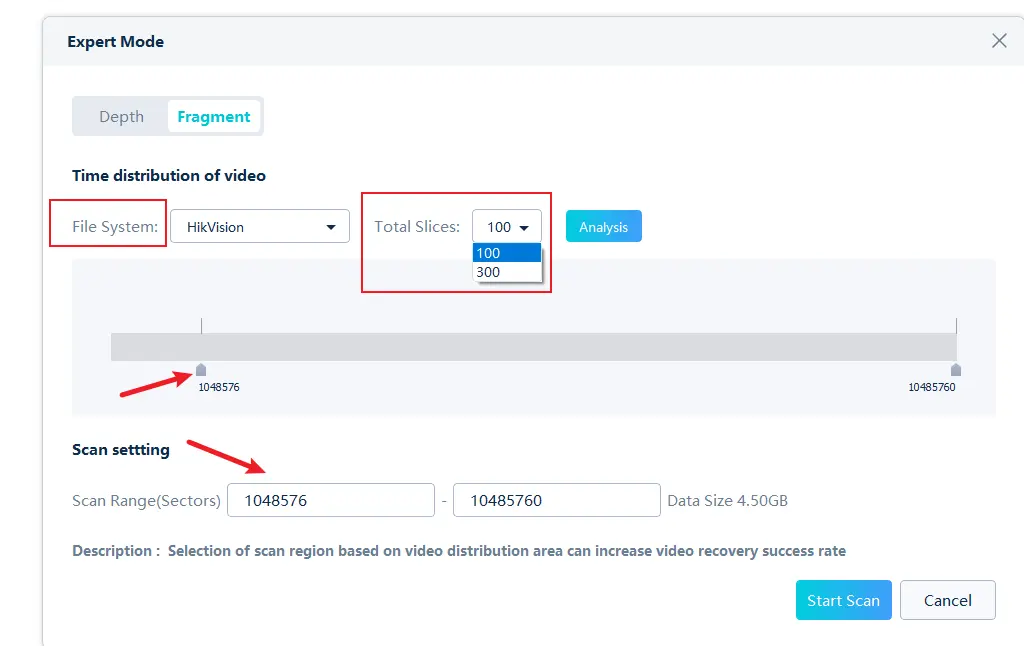
VIP3.0's expert-mode fragmentation analysis workflow

VIP3.0’s expert-mode fragmentation analysis workflow

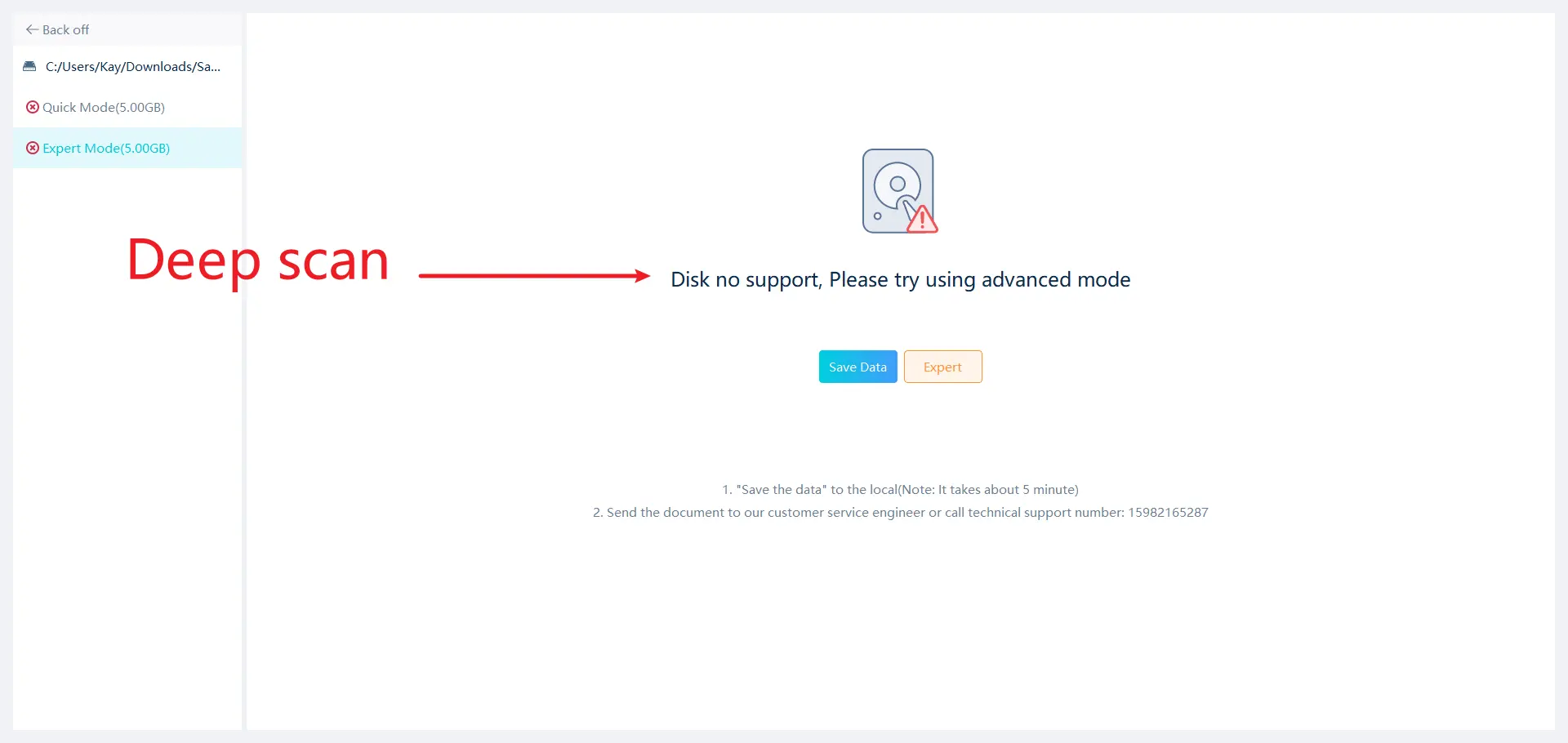
Where deep scanning came up empty on this drive, the fragmentation recovery process successfully reconstructed the footage investigators needed.

Deep scan vs. fragmentation recovery results on the same drive

Deep scan vs. fragmentation recovery results on the same drive

The Outcome

The recovered video captured the suspect’s direction of flight — evidence that had been effectively erased from the system just moments earlier. Acting on that lead, investigators launched a timely pursuit and successfully apprehended the suspect, closing the case.

Looking Ahead

Surveillance storage continues to evolve quickly. Next-generation NVR systems are moving toward full-disk cloud storage, with single-unit capacities now scaling to 16TB and 24TB. As these systems grow larger and more complex, the forensic techniques used to examine them have to keep pace — which is why SalvationDATA continues to invest in capabilities like broader compatibility across proprietary NVR/DVR systems, and multi-source collaborative forensic workflows, so investigators can recover critical evidence no matter how storage technology changes.