FAS7900 – A streamlined forensic acquisition system for fast, non-invasive data extraction and analysis, without the need for computer disassembly. Supporting multiple OS, it captures memory and disk images, and includes secure data wiping.
Forensic Expansion Dock – A compact solution for fast, reliable data acquisition from various storage media. With support for multiple interfaces, it ensures secure, stable, and high-speed forensic data transfer for streamlined workflows.
8 Common Types of Digital Evidence Used in Modern Investigations
Knowledge
2022-10-09
Last Update: 2026-7-17
A large part of modern investigations now revolves around digital evidence. Smartphones, computers, cloud services, messaging apps, and online platforms continuously generate data that can reveal communications, user behavior, locations, and activity timelines.
This type of evidence plays an important role in criminal investigations, cybersecurity incidents, fraud cases, and corporate inquiries. Emails, chat records, videos, browser history, GPS data, and cloud files can all provide valuable investigative insights.
Because digital evidence exists across many different systems and devices, each type often requires different acquisition, preservation, and analysis methods. This article explores the most common types of digital evidence and their role in modern digital forensics.
Digital evidence refers to any electronically stored or transmitted information that may support an investigation. It can help investigators identify user activity, establish timelines, verify communications, or reconstruct events.
This type of evidence can exist across many different sources, including smartphones, computers, cloud platforms, networks, USB drives, and other storage media. Emails, chat messages, photos, videos, browser history, GPS records, and system logs are all common examples of digital evidence.
In many investigations, digital evidence also includes metadata such as timestamps, device information, login records, and file activity. These details often help investigators understand when data was created, accessed, modified, or transferred.
Why Digital Evidence Matters in Modern Investigations
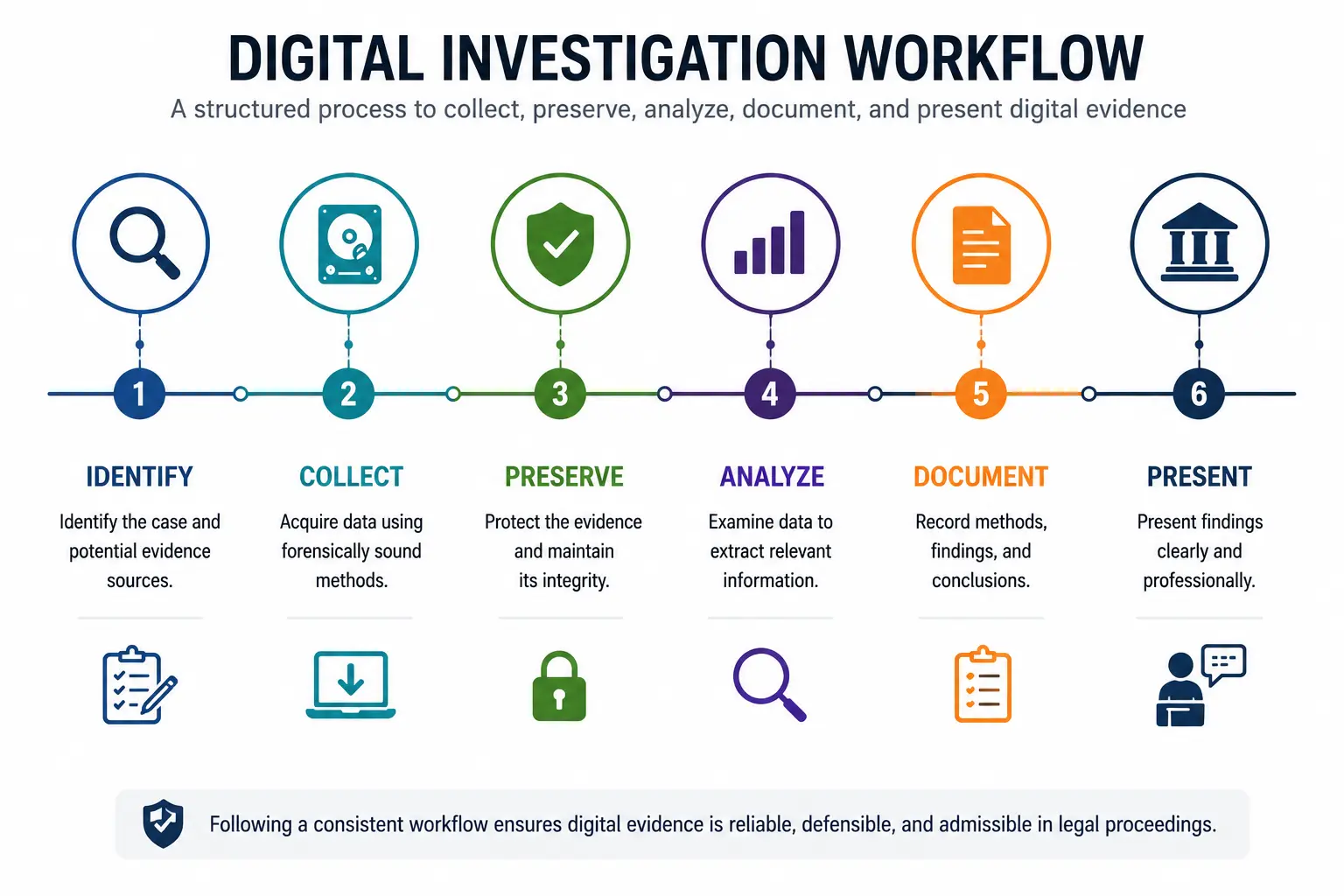
Digital Investigation Workflow: From Evidence Identification to Reporting
Digital evidence plays a major role in modern investigations because many activities now leave a digital trace. Messages, emails, GPS records, browsing activity, cloud data, and media files can help investigators reconstruct events and establish timelines.
In criminal investigations, digital evidence is often used to identify communications, track movements, and analyze user activity across devices and online platforms. In corporate investigations, it may help detect insider threats, policy violations, intellectual property theft, or unauthorized data access.
Digital evidence is also critical in cyber investigations and incident response. Network logs, access records, malware artifacts, and cloud activity can help investigators understand how an attack occurred and determine its impact.
As communication and data storage increasingly shift toward smartphones, cloud services, and encrypted applications, digital evidence has become more distributed and more complex. This has made proper forensic acquisition, preservation, and analysis more important than ever in modern digital investigations.
8 Common Types of Digital Evidence
Digital evidence can exist across many different devices, platforms, and storage environments. Each type of evidence may contain unique investigative value and often requires different forensic acquisition and analysis methods.
Below are some of the most common types of digital evidence encountered in modern investigations.
1. Mobile Device Evidence
Mobile device evidence is one of the most important categories of digital evidence today. Smartphones are deeply integrated into daily communication, online activity, navigation, media creation, and cloud synchronization, making them a valuable source of forensic information.
A smartphone may contain:
Text messages and chat records
Call logs and contact information
Application and social media data
GPS and location history
Photos and videos
Browser history and search activity
Account and cloud synchronization records
In many cases, mobile device evidence helps investigators reconstruct timelines, identify communications, verify locations, and analyze user behavior. As a result, smartphones are frequently examined in fraud investigations, missing person cases, insider threat investigations, cybercrime cases, and corporate investigations.
From a forensic perspective, mobile devices can also present significant challenges. Encryption, locked devices, cloud synchronization, and application-specific data storage may affect how evidence is acquired and analyzed. Because of this, smartphone forensics often requires specialized forensic acquisition and examination tools designed to preserve data integrity throughout the investigative process.
Example: In a missing person case, GPS location history and app-based location logs extracted from a smartphone can help investigators reconstruct the individual’s last known movements.
2.Computer and Laptop Evidence
Computers and laptops remain a major source of digital evidence in both criminal and corporate investigations. These systems often contain large amounts of user-generated data, activity records, and system artifacts that can help investigators understand how a device was used.
Common types of computer and laptop evidence include:
Documents and spreadsheets
Emails and attachments
Browser history and download records
USB connection history
System logs and user account activity
Recently accessed files
Application usage records
In forensic investigations, this type of evidence is frequently used to establish timelines, identify file access activity, trace external storage usage, and analyze user behavior on a system.
Computer and laptop evidence is commonly examined in corporate investigations, intellectual property theft cases, insider threat investigations, and malware incidents. In cybersecurity investigations, system artifacts and log records may also help investigators determine how unauthorized access or malicious activity occurred.
Because digital data on computers can be modified, deleted, or encrypted, forensic acquisition methods are typically used to preserve the integrity of the original evidence during examination and analysis.
3.Cloud Evidence
Cloud evidence has become increasingly important in modern digital investigations as more personal and business data is now stored and synchronized through cloud services.
Unlike traditional local storage, cloud data may exist across multiple devices, remote servers, and synchronized accounts at the same time. Even when files are deleted from a device, related data may still remain available in cloud backups or account records.
Common types of cloud evidence include:
Cloud backups and synchronized files
Email and online account data
Shared documents and collaboration records
Cloud-stored photos and videos
Account login history
Device synchronization records
Cloud evidence is frequently encountered in fraud investigations, corporate investigations, cybercrime cases, and incident response activities. Investigators may use cloud artifacts to establish user activity, verify file access history, identify connected devices, and reconstruct account behavior across multiple platforms.
From a forensic perspective, cloud evidence can present additional challenges due to remote storage, multi-device synchronization, encryption, and jurisdictional considerations. Proper acquisition and preservation methods are often required to maintain the integrity and authenticity of cloud-based evidence during a forensic investigation.
4.Email Evidence
Email evidence remains one of the most commonly examined forms of digital evidence in forensic investigations. Emails often contain communication records, file attachments, timestamps, sender information, and other metadata that can help investigators reconstruct events and verify user activity.
Common types of email evidence include:
Email conversations and message content
Attachments and transferred files
Sender and recipient information
Header metadata
Login and access records
Deleted or archived emails
Email header data can be especially important in forensic investigations because it may reveal routing information, originating IP addresses, server paths, and message transmission details.
Email evidence is frequently used in financial fraud investigations, phishing investigations, business email compromise (BEC) cases, and corporate investigations involving unauthorized communications or data leakage.
Because email data may exist across local devices, cloud platforms, and mail servers simultaneously, forensic investigators often need to preserve both message content and associated metadata to maintain evidential integrity during analysis.
Example: In a phishing or business email compromise investigation, email header metadata can help identify the sender’s originating IP address and the mail server path a fraudulent message actually traveled through.
5.Chat and Social Media Evidence
Chat and social media evidence has become an important source of digital evidence as communication increasingly takes place through messaging apps and online platforms.
This type of evidence can help investigators establish timelines, identify communications, and analyze user activity across platforms. It is frequently encountered in criminal investigations, fraud cases, cybercrime investigations, and corporate inquiries.
From a forensic perspective, encrypted messaging applications introduce additional challenges. Features such as end-to-end encryption, disappearing messages, and platform-specific storage methods can affect evidence acquisition and analysis.
Example: In a fraud investigation, deleted WhatsApp or Telegram conversations recovered from a device can help establish direct communication between parties even after messages were removed from the app.
6.Video and Image Evidence
Video and image evidence provides visual documentation of events, individuals, locations, and activities. Because of its ability to capture what occurred at a specific time and place, it is often a valuable source of information in digital and criminal investigations.
Common sources include:
CCTV footage
Dashcam recordings
Smartphone photos and videos
Surveillance systems
Body-worn cameras
This type of evidence is frequently used in criminal investigations, traffic accident investigations, workplace incidents, and public safety cases. Investigators may use video and image evidence to verify events, establish timelines, identify individuals, and corroborate other forms of digital evidence.
However, analyzing video evidence is not always straightforward. Investigators may encounter fragmented video files, corrupted recordings, missing footage, or inconsistencies in metadata. As a result, both the content itself and the associated metadata often require careful examination during a forensic investigation.
Example: In a traffic accident investigation, dashcam footage recovered from a damaged or reformatted memory card can help reconstruct the sequence of events leading up to a collision.
7. Network and Internet Activity Evidence
Network and internet activity evidence records how devices communicate with networks, online services, and other systems. This type of evidence is particularly important in cybersecurity investigations because it can reveal when, where, and how digital activities occurred.
Common sources include:
IP address logs
Network traffic records
User access logs
Wi-Fi connection records
Firewall and router logs
Website access history
Network evidence can help investigators identify suspicious connections, trace user activity, establish timelines, and determine whether unauthorized access has occurred. In many cases, it provides critical context that may not be available from a single device alone.
This type of evidence is frequently examined in cyberattack investigations, unauthorized access cases, insider threat investigations, and incident response activities. By analyzing network and internet activity, investigators can better understand how systems were accessed, what actions were performed, and whether data was transmitted or compromised.
Example: In an unauthorized access investigation, firewall and access logs can help identify when an intrusion occurred and which internal systems were reached.
8. Storage Media Evidence
Storage media evidence refers to data stored on devices that may contain files, system artifacts, and other information relevant to an investigation.
Common sources include:
Hard disk drives (HDDs)
Solid-state drives (SSDs)
USB flash drives
SD and microSD cards
These devices can contain documents, emails, photos, videos, application data, and other digital artifacts. In some cases, deleted or formatted data may still contain recoverable evidence, making storage media an important source of information in digital investigations.
Storage media evidence is frequently examined in criminal investigations, corporate investigations, data theft cases, and incident response activities.
Example: In a data theft case, files deleted from a suspect’s USB drive shortly before it was seized may still be recoverable, depending on whether the underlying storage blocks have been overwritten.
Challenges in Handling Digital Evidence
Collecting digital evidence is only part of the investigative process. Investigators must also ensure that the evidence remains accurate, reliable, and legally defensible throughout the examination.
Common challenges include:
Encryption– Modern devices, applications, and cloud services increasingly use encryption, which can limit access to potentially valuable evidence.
Secure Deletion– Some systems are designed to permanently remove data, reducing the likelihood of recovery.
Cloud Fragmentation– Evidence may be distributed across multiple devices, cloud platforms, and synchronized accounts.
Large Data Volumes– Modern investigations often involve processing large amounts of digital data from multiple sources.
Chain of Custody– Evidence handling must be properly documented to demonstrate that data has not been altered during the investigation.
Metadata Integrity– Timestamps, file attributes, and other metadata must be preserved because they can provide critical context for forensic analysis.
Addressing these forensic challenges is essential for effective digital evidence preservation. Proper acquisition, documentation, and analysis help ensure that digital evidence remains reliable throughout the investigative process.
How Digital Evidence Is Preserved
Preserving digital evidence is a fundamental part of the forensic process. The objective is to collect, analyze, and store data in a way that preserves its authenticity and prevents unintended changes.
A typical digital forensic workflow follows this process:
At each stage, investigators must ensure that the original evidence remains unchanged and that all activities are properly documented.
Several techniques are commonly used to preserve digital evidence:
Forensic Imaging – A bit-for-bit copy of the original device or storage media is created, allowing investigators to examine the copy while preserving the original evidence.
Write Protection – Hardware or software write blockers are used during acquisition to prevent data from being modified.
Hash Verification – Cryptographic hash values are generated to verify that the acquired data matches the original evidence and remains unchanged.
Evidence Integrity Controls – Standardized forensic procedures help ensure that evidence remains accurate and reliable throughout the investigation.
Documentation and Reporting – Investigators record acquisition methods, examination activities, and findings to maintain transparency and accountability.
These practices help maintain evidence integrity throughout the forensic workflow. Proper preservation not only protects the original data but also supports the credibility and reliability of investigative findings.
Best Practices for Handling Digital Evidence
Digital evidence can provide valuable insights, but its reliability depends on how it is collected, preserved, and analyzed. Even highly relevant evidence may lose investigative value if proper forensic procedures are not followed.
A common example is a corporate investigation involving suspected intellectual property theft. If investigators access a computer directly and unintentionally modify files or timestamps, the authenticity of the evidence may later be questioned. Similar risks can occur during cybercrime investigations, where incomplete log collection or poor documentation may affect the reconstruction of events.
To help ensure reliable results, investigators should follow several key principles:
Preserve original evidence whenever possible.Analysis should be conducted on forensic copies rather than source devices.
Use validated acquisition methods.Consistent and repeatable procedures help reduce the risk of data alteration.
Verify evidence integrity.Hash verification can help confirm that acquired data remains unchanged throughout the investigation.
Maintain a clear chain of custody.All evidence handling activities should be documented, including collection, transfer, storage, and analysis.
Document investigative findings thoroughly.Proper reporting helps establish transparency and supports later review.
These practices are particularly important when dealing with mobile devices, cloud data, encrypted communications, and large-scale digital investigations. As evidence sources become more diverse, maintaining a structured forensic workflow is essential for ensuring that digital evidence remains reliable, defensible, and useful throughout the investigation process.
Conclusion
Digital evidence plays a vital role in modern investigations. From mobile devices and cloud platforms to networks and storage media, valuable evidence can exist across many digital sources.
To ensure reliable results, investigators must follow proper acquisition, preservation, and documentation procedures throughout the forensic process.
As technology continues to evolve, digital evidence is becoming increasingly complex, making sound forensic practices more important than ever.
FAQs
Q1: What are the 8 types of digital evidence? A: Mobile device evidence, computer and laptop evidence, cloud evidence, email evidence, chat and social media evidence, video and image evidence, network and internet activity evidence, and storage media evidence are the eight categories covered in this guide.
Q2: What is the most common type of digital evidence in investigations? A: Mobile device evidence is among the most frequently examined, given how deeply smartphones are integrated into daily communication, location tracking, and app-based activity.
Q3: What makes digital evidence legally defensible? A: A properly maintained chain of custody, validated acquisition methods, and hash verification are the core requirements for ensuring digital evidence remains admissible and reliable.
Q4: Can evidence acquired with consumer-grade tools hold up in an investigation? A: It depends on the acquisition method’s repeatability and whether it preserves the original data unmodified. Forensic-grade tools that support write-blocking and hash verification are generally preferred over consumer software for evidence intended to be legally defensible.
Q5: Which type of digital evidence should investigators prioritize collecting first? A: Volatile data — such as active network connections, running processes, and RAM contents — should generally be prioritized, since it can be lost the moment a device is powered off or disconnected, unlike storage media evidence which typically persists.