FAS7900 – A streamlined forensic acquisition system for fast, non-invasive data extraction and analysis, without the need for computer disassembly. Supporting multiple OS, it captures memory and disk images, and includes secure data wiping.
Forensic Expansion Dock – A compact solution for fast, reliable data acquisition from various storage media. With support for multiple interfaces, it ensures secure, stable, and high-speed forensic data transfer for streamlined workflows.
Understanding MD5 and SHA: File Integrity with Hash Functions
Knowledge
2025-04-17
File integrity refers to the assurance that a file remains complete, unchanged, and unaltered from its original state. In the digital environment—where data underpins every operation—maintaining this integrity, especially during file extraction, is non-negotiable. Even a single bit of modification will result in a different digital signature, making integrity a measurable property.
In practice, file integrity is critical in scenarios such as data transfer, storage, and digital forensics. Investigators must be able to prove that evidence has not been modified during acquisition, imaging, or analysis, as any alteration can undermine its reliability and admissibility.
To ensure this, cryptographic hash functions such as MD5 and SHA act as reliable safeguards. MD5, with its long-standing use, offers speed and broad compatibility, while SHA provides enhanced security. Together, they enable efficient verification of file integrity, helping ensure that data remains intact and trustworthy throughout the process.
In the digital age, data integrity is a core requirement across e-forensics and data backup workflows. Even minor file alterations can compromise investigative outcomes or render backups unusable, leading to serious operational and evidential risks.
To mitigate these issues, integrity verification techniques such as MD5 and SHA are widely adopted. These are based on cryptographic hash functions: MD5 is optimized for speed and simplicity, while SHA (including SHA-1, SHA-2, and SHA-3) offers varying levels of security and robustness. To better understand how these mechanisms ensure data integrity, it is necessary to first clarify two foundational concepts: hash functions and checksums.
Understanding of the MD5 and SHA checksum
MD5 and SHA are just different types of hash functions. They rely on the features of hash functions to keep data in check and boost security. You may ask, “What is a hash function?” So now, let’s begin by figuring out what exactly a hash function is.
A hash is a fixed-length digital output generated from input data to uniquely represent and verify its integrity.
What is a hash function?
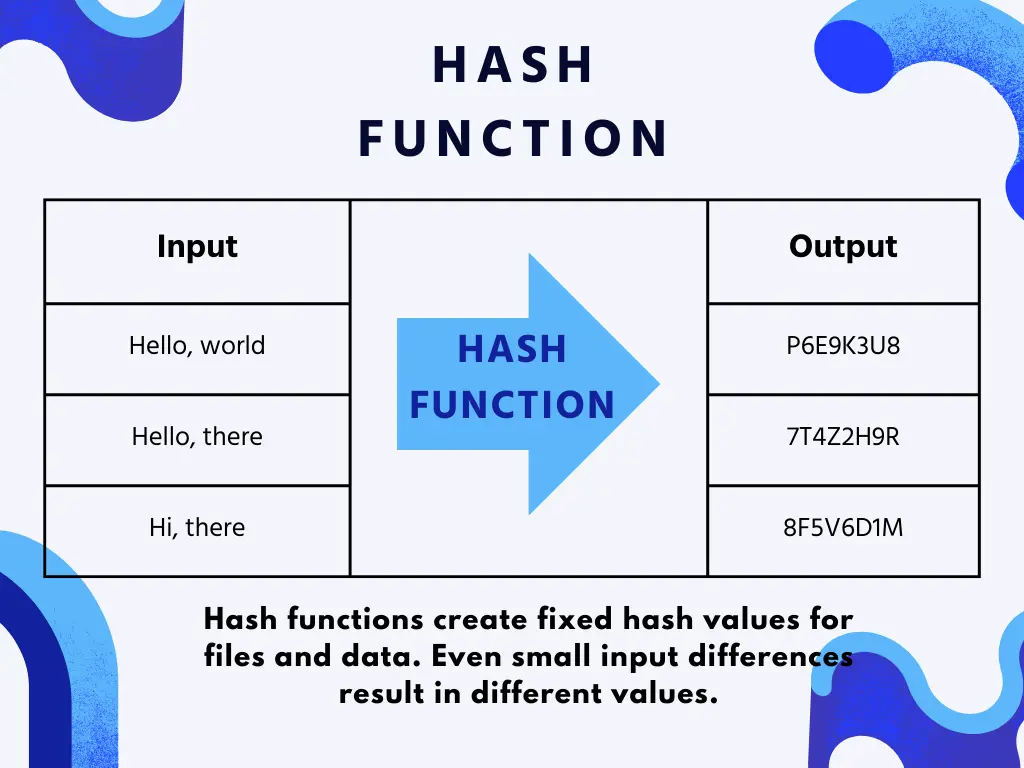
The hash function is the function that maps data of any size to fixed – size hash values. It has the avalanche effect (small input change leads to large hash change).
What is checksum?
A checksum is a value generated from a file or data set to verify its integrity. It acts as a digital fingerprint: if the data changes in any way, the checksum will also change. This makes it a simple and effective method for detecting corruption or tampering.
Checksums are widely used during data transfer, storage, and forensic analysis to confirm that files remain unchanged. In many cases, these checksums are produced using hash functions, which generate fixed-length outputs regardless of input size.
How hashing works?
Hashing converts input data (such as a file or text) into a fixed-length output called a hash value using a hash algorithm, effectively creating a unique digital fingerprint of the original data.
What are MD5 and SHA?
MD5: MD5 message-digest algorithm is a has function which is widely used for producing a 128-bit hash value. It is designed Ronald Rivest in 1991 to replace earlier MD4. It generates 128-bit hash value for ensuring file integrity.
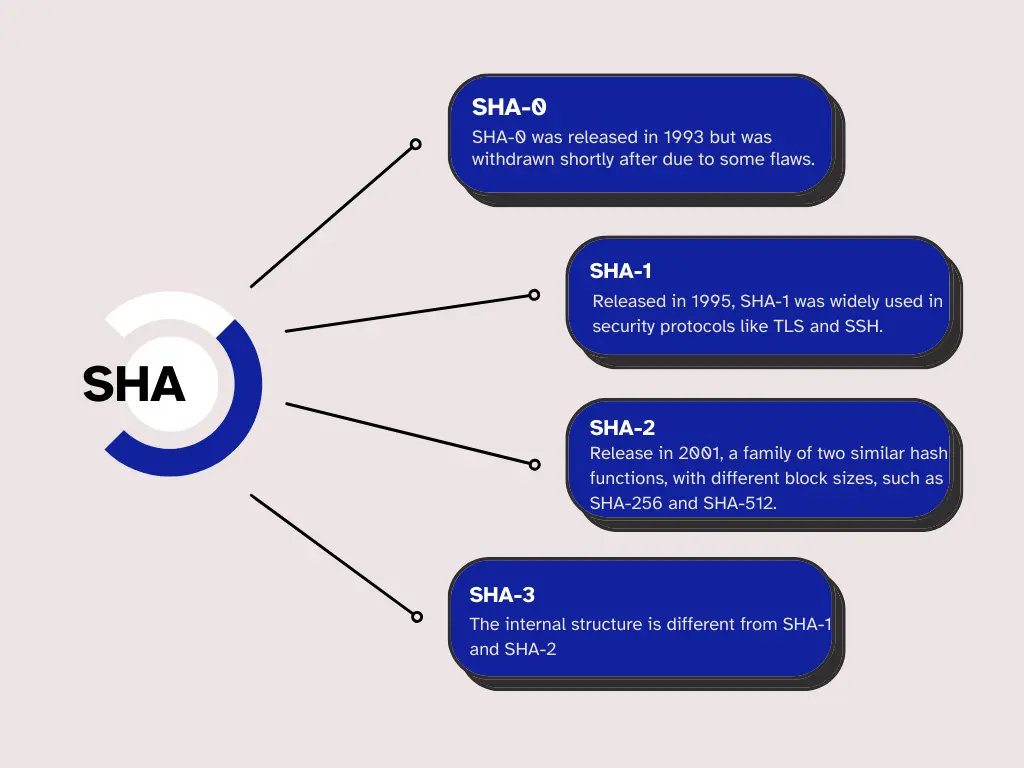
SHA: SHA: The Secure Hash Algorithms, published by NIST, are a series of cryptographic hash functions, including SHA-1 (1995), SHA-2 (2001, e.g., SHA-256, SHA-512), and SHA-3 (2015).
SHA is a family of cryptographic hash algorithms developed by NIST to ensure data integrity and security.
Security Profile: SHA v.s. MD5
MD5 and SHA are two widely used cryptographic hash algorithms that serve the same core purpose—verifying data integrity—but differ significantly in their design, security strength, and reliability. In practice, they are often compared against each other rather than viewed in isolation, as the choice between them directly impacts the robustness of integrity verification in applications such as digital forensics, file validation, and secure data handling.
MD5 Overview
MD5 (Message Digest Algorithm 5) generates a 128-bit hash value and is known for its high processing speed and computational efficiency. It has historically been widely used for quick integrity checks and non-security-critical applications.
However, MD5’s simplicity also introduces weaknesses, particularly in terms of collision resistance, which limits its reliability in modern security and forensic contexts.
SHA Overview
SHA (Secure Hash Algorithm) represents a family of hashing algorithms designed to provide stronger security guarantees than MD5. Compared with MD5, SHA produces longer hash outputs and is built to withstand more advanced cryptographic attacks.
As a result, SHA is generally considered the more secure and reliable option, especially in environments where data integrity is critical.
MD5 vs SHA: Key Differences
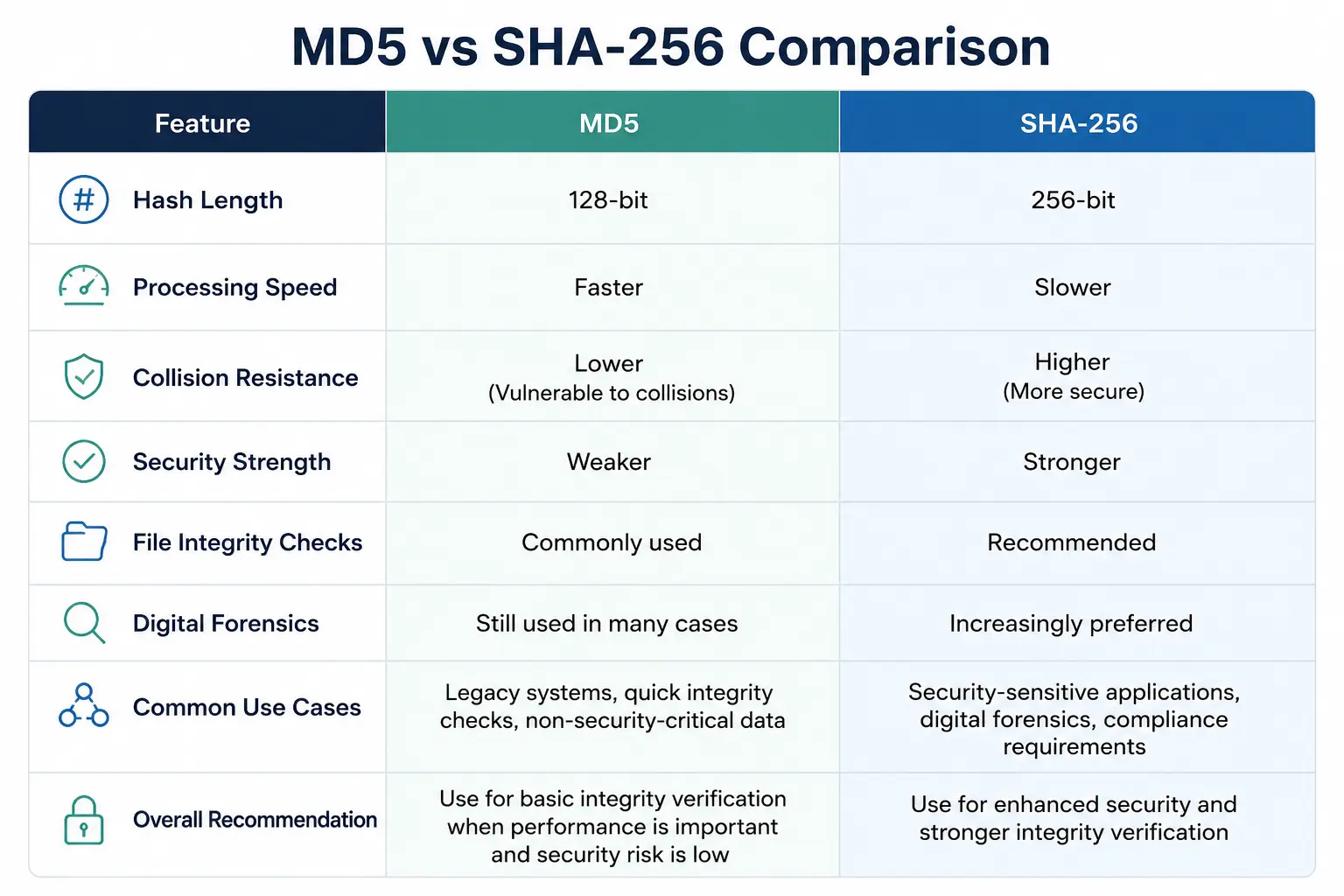
MD5 vs SHA-256 Comparison for File Integrity Verification.
Although both MD5 and SHA serve the same fundamental purpose—verifying data integrity—they differ significantly in performance and security characteristics.
Speed: MD5 is generally faster and requires fewer computational resources, making it suitable for non-critical or performance-sensitive integrity checks.
Security: SHA algorithms provide a higher level of security due to their more complex design and longer output length, making them significantly more resistant to modern cryptographic attacks.
Collision Risk: One of the most critical differences lies in collision resistance. MD5 is vulnerable to hash collisions, meaning that different files can produce the same MD5 hash value, which undermines its reliability in security-sensitive contexts. In contrast, SHA significantly reduces this risk, especially in its more modern variants.
As a result, while MD5 may still be used for basic verification tasks, SHA is generally preferred in environments where data integrity and security are paramount.
Balancing Speed and Security
In practical applications, the choice between MD5 and SHA often comes down to a trade-off between performance and security. MD5 prioritizes speed and efficiency, while SHA prioritizes robustness and resistance to tampering. As a result, MD5 may still be used in non-critical scenarios, whereas SHA is preferred in contexts where data integrity must be strictly guaranteed.
Are MD5 secure and SHA?
In 2004, the MD5 is shown that it is not collision-resistant. This collision vulnerability results in the same hash value being generated for two different inputs. However, MD5 still has its own little corner. In situations where security isn’t a major concern, such as when home users are just doing basic checks to see if their backup files are okay, or when there’s hardly any chance of a collision attack happening, MD5 can still come in handy. After all, it’s simple to use and really fast.
SHA is far more secure. SHA – 1 has issues and is being phased out. SHA – 2, with its long – length hashes, is a security staple, as seen in Bitcoin and SSL/TLS. SHA – 3, developed against future threats like quantum attacks, offers similar security and is gaining ground in high – security fields.
Role of MD5 and SHA in Digital Forensics
File integrity verification helps ensure that data remains accurate and unchanged during storage, transfer, and analysis. By comparing checksum or hash values, users can quickly detect corruption, transmission errors, or unauthorized modifications.
This practice is widely used in software distribution, data recovery, cybersecurity, and digital forensics, where maintaining data authenticity and reliability is essential.
Beyond general file integrity verification, MD5 and SHA play a critical role in digital forensic investigations. Investigators use cryptographic hash values throughout the forensic workflow to verify evidence integrity and demonstrate that digital evidence has remained unchanged during acquisition, transfer, storage, and analysis.
Hash verification can be performed at multiple stages of this process to help maintain the authenticity and reliability of digital evidence.
Evidence Integrity Verification Hash values generated during evidence collection are compared before and after handling to ensure the data has not been modified. A match confirms integrity.
Forensic Imaging Validation After disk imaging, the hash of the original data is compared with the forensic image to confirm a bit-for-bit identical copy. This is a core step in forensic acquisition workflows such as DRS and FAS.
Duplicate File Detection Hashing enables quick identification of duplicate files by comparing hash values instead of file contents, improving analysis efficiency in large datasets.
Court Admissibility Consistent hash verification helps demonstrate evidence integrity and supports compliance with forensic standards, strengthening the reliability and admissibility of digital evidence in court.
Best Practices in Forensic Hashing
Use dual hashing (MD5 + SHA-256) Combining MD5 and SHA-256 improves workflow efficiency while maintaining stronger verification. MD5 supports fast processing, while SHA-256 provides higher security assurance.
Record and preserve hash values throughout the workflow Hash values should be generated at acquisition and consistently maintained across all investigation stages to ensure continuous integrity verification and traceability.
Maintain a read-only forensic environment All analysis should be conducted in a write-protected or read-only mode to prevent any modification of original evidence and preserve its authenticity.
FAQ
What is a hash checksum? A hash checksum is a fixed-length value generated by a hash function to verify data integrity. Any change in the file results in a different checksum.
What are MD5 and SHA? MD5 and SHA are cryptographic hash functions used to generate unique hash values for data verification and integrity checks.
What is the difference between MD5 and SHA-256? MD5 is faster but vulnerable to hash collisions. SHA-256 is more secure and widely used in forensic and security-sensitive applications.
How are hash values used in digital forensics? Hash values are used to verify that digital evidence has not been altered during acquisition, imaging, or analysis.
Why is SHA-256 preferred in digital forensics? SHA-256 provides stronger collision resistance, ensuring higher reliability when validating evidence integrity.
Can two different files have the same hash value? Yes, this is called a hash collision. It is rare with strong algorithms like SHA-256 but more likely with MD5.
What is hash verification in forensic imaging? It is the process of comparing hash values before and after imaging to ensure the forensic copy matches the original data exactly.
How SalvationDATA Supports Hash Verification
Automated hash verification across workflows SalvationDATA platforms automatically generate hash values during key forensic processes, reducing manual intervention and ensuring consistent integrity validation throughout investigations.
Multi-algorithm support for forensic standards Solutions including DRS, DBF, FAS, and AFA9500 support widely used hashing algorithms such as MD5 and SHA-256, enabling compliance with different forensic requirements and operational standards.
Integrated into end-to-end forensic workflows Hash verification is embedded across core modules:
Integrated into end-to-end forensic workflows Hash verification is embedded across core modules:
DRS (Data Recovery): validates data integrity during recovery from damaged or complex storage media
DBF (Database Forensics): ensures consistency and reliability of structured data extraction and analysis
FAS (Field Acquisition System): verifies evidence integrity at the point of on-site acquisition
AFA9500 (Mobile Forensics): supports secure extraction and validation of mobile device data
End-to-end evidence reliability assurance From acquisition through analysis, hash verification is consistently applied to ensure digital evidence remains unchanged, reinforcing forensic reliability and investigative defensibility.