Dashcam Video Recovery: The Importance and Methods of Recovering Dashcam Footage

Product Tips
2026-03-02

Dashcam video refers to continuous in-vehicle recordings captured by dashboard cameras to document road conditions, driver behavior, and unexpected incidents. Today, dashcams have achieved widespread global adoption, driven by increasing road-safety awareness, rising insurance fraud concerns, and stronger demand for reliable digital evidence among both individual drivers and commercial fleet operators. Industry market analysis indicates sustained worldwide growth as more users rely on recorded footage for accident investigation and claims verification (Grand View Research, Dash Cam Market Size, Share & Industry Analysis, available at: https://www.grandviewresearch.com/industry-analysis/dashboard-camera-market).

However, dashcam footage is particularly vulnerable to loss or damage. Loop recording may overwrite critical moments, flash storage can suffer corruption or wear from continuous write cycles, and sudden power loss during collisions often produces incomplete or fragmented files. Accidental deletion and improper formatting further increase the risk of missing key evidence.

As a result, dashcam video recovery and dashcam footage recovery have become essential for drivers, investigators, insurers, and fleet managers. The ability to restore deleted or damaged recordings directly supports accident reconstruction, liability assessment, and compliance investigations, ensuring that critical digital evidence is not permanently lost.

The Importance of Dashcam Video Recovery

Dashcam footage is often most needed in the moments when an incident occurs — yet it is also highly vulnerable to being lost, overwritten, or corrupted. Effective dashcam video recovery ensures that this crucial visual evidence remains available whenever accountability, legal responsibility, or personal safety is at stake.

Accident Liability Determination

In traffic collisions, dashcam recordings provide an objective, time-stamped record of road conditions, vehicle movements, and driver behavior. Recovered footage allows investigators to reconstruct events more accurately, reducing reliance on conflicting witness accounts and supporting fair, evidence-based liability determinations.

Insurance Claims and Anti-Fraud Investigations

Insurance providers increasingly rely on video evidence to verify claims and identify staged accidents or fraudulent reports. Effective dashcam footage recovery can restore deleted or partially corrupted recordings, helping clarify incident timelines and reduce financial losses associated with false or disputed claims.

Law Enforcement and Judicial Evidence

Recovered dashcam footage is frequently used in law enforcement investigations and court proceedings. From hit-and-run cases to public safety violations, properly restored recordings help preserve critical scene details and strengthen the evidentiary chain, ensuring that key information is not permanently lost.

Personal Safety and Travel Records

Beyond professional investigations, dashcams also provide valuable protection for everyday drivers. Recovering lost recordings can help document road disputes, harassment incidents, or unexpected emergencies, while also preserving meaningful travel memories and long-distance driving experiences.

Common Dashcam Storage Methods

Understanding how dashcam footage is stored is essential for effective dashcam video recovery. Different storage architectures directly influence how data is recorded, overwritten, and recovered after deletion or damage. Today, most dashcams rely on either removable local storage or cloud-based recording systems, each offering distinct advantages as well as unique recovery challenges.

SD / microSD Card Storage

Most consumer and commercial dashcams store recordings on SD or microSD cards because they are portable, cost-effective, and easy to replace. These devices typically rely on loop recording, automatically overwriting older footage once storage capacity is reached. While this ensures continuous recording, it also increases the risk of important videos being unintentionally erased. Frequent write cycles can also accelerate flash memory wear, potentially causing file system corruption, bad sectors, or fragmented video files. In such situations, professional dashcam footage recovery often depends on deep data scanning and video structure reconstruction to restore usable recordings.

Cloud-Based Storage

Many modern dashcams offer cloud storage via wireless connectivity, automatically uploading footage to remote servers for backup and convenient remote access. Cloud recording lowers the risk of data loss from physical damage, theft, or storage card failure, making it especially valuable for fleet management and security monitoring. However, recovery challenges can still occur due to interrupted uploads, subscription limits, synchronization errors, or accidental deletions from cloud accounts. In such cases, effective recovery may involve server-side backups, account-level restoration tools, or specialized forensic acquisition methods to ensure the integrity of critical evidence.

Dashcam Video Recovery Strategies Across Different Storage Architectures

Dashcam Video Recovery from Memory Cards

Recovering dashcam footage from SD or microSD cards is both one of the most common and most critical aspects of dashcam video recovery, since the majority of consumer and commercial devices rely on removable storage. A clear understanding of the storage format and recording behavior is essential for effectively restoring deleted, formatted, or fragmented videos.

  • Common File Systems

Dashcam recordings are generally stored on FAT32 or exFAT file systems, while some devices use proprietary formats tailored for features like loop recording or data protection. Each file system has its own allocation and indexing structure, which directly influences how deleted or fragmented videos can be detected and successfully recovered.

  • Fragmentation Caused by Loop Recording

Loop recording continuously overwrites older files once the storage card reaches capacity, often causing video fragmentation. As a result, segments of a single event may be scattered non-sequentially across the card, making straightforward file recovery more challenging.

  • Recovery Logic for Deleted or Formatted Videos

When videos are deleted or a card is formatted, the original file entries may be erased, but the underlying data often remains until it is overwritten. Recovery typically involves scanning the raw storage data to detect video signatures and reconstruct file boundaries.

  • Importance of Forensic-Grade Read-Only Recovery

To preserve evidentiary integrity, professional dashcam video recovery prioritizes read-only operations. Avoiding any writes to the storage medium prevents further data loss and ensures that recovered footage can serve as admissible evidence in investigations, insurance claims, or legal proceedings.

Cloud-Based Dashcam Video Recovery

As connected vehicles and smart dashcams become more common, cloud storage is increasingly used as a backup layer for critical recordings. Remote synchronization allows footage to remain accessible even when local storage is damaged, overwritten, or lost. However, cloud recovery relies heavily on account access, provider policies, and legal compliance requirements.

  • Cloud Synchronization and Account Access Mechanisms

Cloud dashcams typically upload recordings via Wi-Fi or mobile networks, either automatically or event-triggered, with access tied to authenticated user accounts or fleet management platforms. As a result, forensic recovery relies primarily on authorized account access rather than device-level analysis, allowing investigators to obtain footage through official logins, enterprise dashboards, or vendor data requests, often together with metadata such as timestamps, GPS information, and event logs.

  • Recovery Limitations After Overwriting or Retention Expiration

Cloud-stored recordings are typically governed by storage quotas or retention periods, and once footage is deleted or expires, recovery becomes highly unlikely since investigators cannot perform low-level reconstruction on provider servers. In some cases, however, duplicate copies may still be found on synced smartphones, previously downloaded files, or fleet management systems, making cross-source evidence collection a practical recovery strategy.

  • Compliance and Privacy Considerations in Cloud Forensics

Cloud-based recovery is often shaped by privacy regulations and jurisdictional requirements, especially when accessing third-party platforms or cross-border data. Obtaining proper authorization and carefully documenting acquisition procedures is essential to preserve evidentiary integrity, while using official export tools helps maintain metadata authenticity and a defensible chain of custody.

Technical Challenges in Dashcam Video Recovery

  • Highly Fragmented Files and Missing Index Information: Continuous recording scatters data, and lost indexes make footage incomplete, requiring frame-level or header reconstruction.
  • Partial Overwriting from Loop Recording: Loop recording can partially overwrite key footage, disrupting playback and necessitating partial reconstruction.
  • Aging Media, Bad Sectors, and Physical Damage: Worn microSD cards or physical damage cause read errors, often needing read-only imaging before recovery.
  • Proprietary Formats and Non-Standard Encoding: Custom codecs or formats may be unreadable by standard tools, requiring specialized decoding or vendor solutions.
  • File Corruption from Power Loss or Improper Shutdown: Sudden shutdowns can leave files incomplete; repairing headers or encoding structures is needed to restore playability.

SalvationDATA VIP3.0 Dashcam Video Recovery Solution

SalvationDATA VIP3.0 is a professional video forensics and recovery tool designed to handle complex scenarios where dashcam footage is damaged, deleted, or fragmented.

Video Forensics Solution-VIP3.0

SalvationDATA VIP3.0 is a professional video forensics and recovery tool designed to address complex dashcam footage loss scenarios, including deletion, fragmentation, and partial overwriting.

Built with specialized recovery algorithms, VIP3.0 can reconstruct deleted or damaged dashcam videos by analyzing frame structures, codec characteristics, and file headers. Its intelligent video reorganization capabilities help restore fragmented recordings into playable files, while multi-format parsing ensures compatibility with proprietary or non-standard dashcam encodings.

Designed for law enforcement agencies, forensic laboratories, and professional investigators, VIP3.0 provides a reliable and forensically sound solution for recovering critical dashcam evidence efficiently.

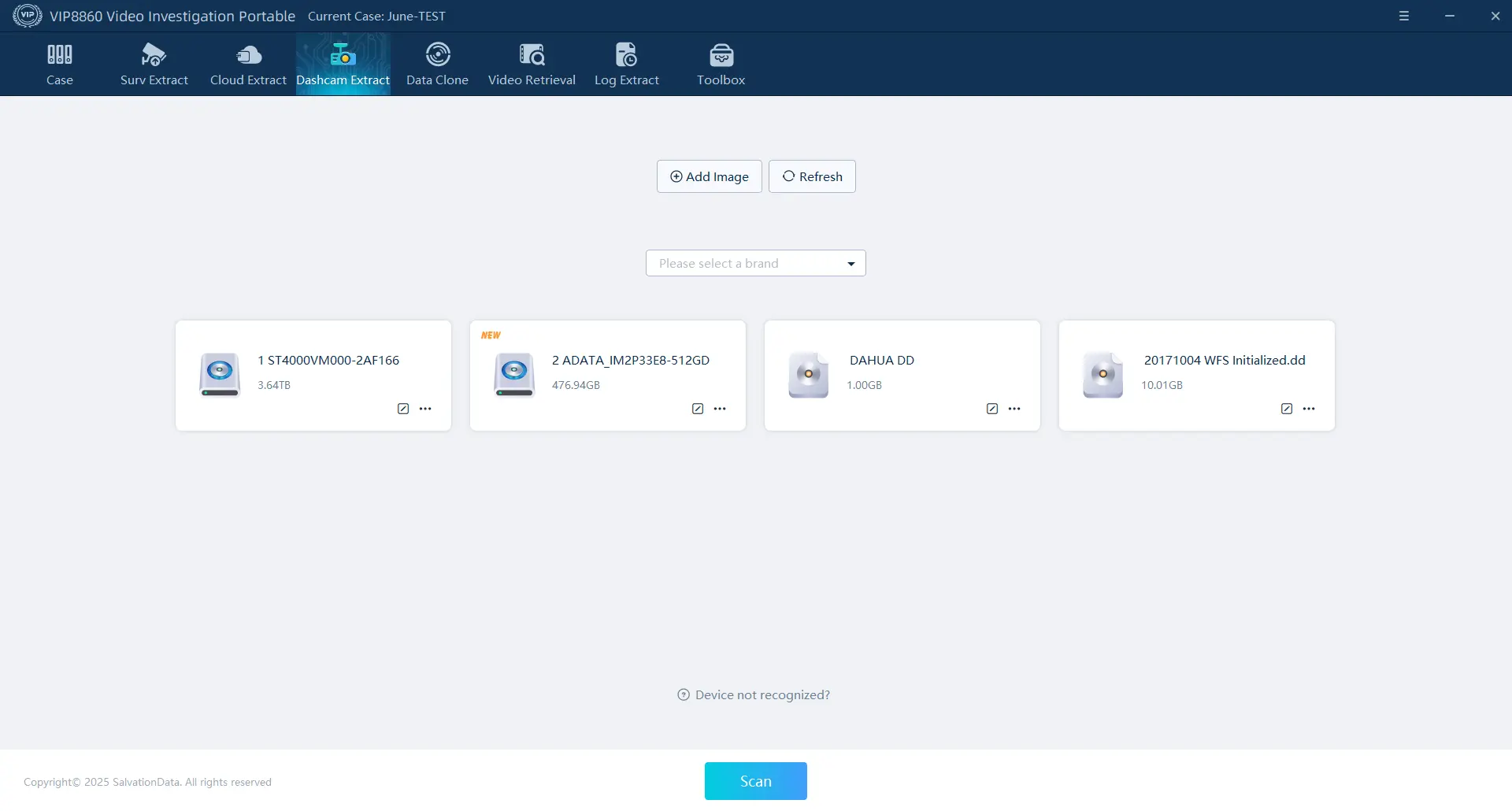
Dashcam Extraction

VIP3.0 – SalvationDATA’s Solution of Dashcam Footage Recovery & Extraction

VIP3.0 Dashcam Footage Recovery and Extraction

VIP3.0 – SalvationDATA’s Solution of Dashcam Footage Recovery & Extraction

Recover Critical Dashcam Evidence with Confidence

Lost or damaged dashcam footage doesn’t have to mean lost evidence. Whether you are dealing with deleted recordings, fragmented files, or proprietary video formats, SalvationDATA VIP3.0 provides the forensic-grade tools needed to restore and analyze critical video data efficiently. Contact our team today or request a demo to discover how VIP3.0 can strengthen your dashcam video recovery and investigative workflow.