FAS7900 – A streamlined forensic acquisition system for fast, non-invasive data extraction and analysis, without the need for computer disassembly. Supporting multiple OS, it captures memory and disk images, and includes secure data wiping.
Forensic Expansion Dock – A compact solution for fast, reliable data acquisition from various storage media. With support for multiple interfaces, it ensures secure, stable, and high-speed forensic data transfer for streamlined workflows.
Write a Forensic Report Step by Step [Examples Inside]
Work Tips
2022-11-07
Last Update: 2026-7-29
To present the evidence in a way the court deems admissible and bring the guilty to justice, formulating a coherent and comprehensive digital forensics report is crucial. Without one, retelling the events that occurred in a structured manner, all while backing up every claim with concrete evidence, would be next to impossible (hence they are a requirement in the court proceedings).
Digital forensics reports play an instrumental role in coordinating the work between multiple investigators, law enforcement officers, administrative, and legal personnel involved in the case, not all of which may share the same professional background and field of expertise.
They are the interdisciplinary focal point that tells the truth of what happened and documents the findings, all while presenting them in a factual yet understandable manner.
At the same time, investigators should keep in mind that other law enforcement institutions may ask for the report in order to:
Get a recap of events
Determine the next steps to take
Review the evidence
Verify what digital forensics tools have been used
Get an overview of the investigation’s objectives
etc.
Before we reveal the exact steps on how to formulate one, keep in mind that the exact structure of a digital forensic report depends on the case, which means what you will find below is a general overview of the entire process in a step-by-step manner as well as a general outline to follow which should give you some ideas on how to tackle the task at hand.
To give you a better idea how the final result should look, we’ve also provided some concrete digital forensic report examples from different cases.
According to the National Institute of Standards and Technology (NIST), digital forensics involves the identification, collection, examination, and analysis of digital evidence while preserving its integrity. A digital forensic report is the formal document used to record and communicate the results of that process.
A forensic investigation report typically documents the evidence examined, the methods and tools used, the analysis performed, and the findings obtained during an investigation. It provides a clear and structured record of how conclusions were reached and helps ensure that investigative results can be reviewed, understood, and verified by others.
Digital forensic reports are commonly used in:
Criminal investigationsinvolving computers, mobile devices, or digital evidence.
Corporate investigationsrelated to employee misconduct, data theft, or policy violations.
Incident responseactivities following cybersecurity breaches or security incidents.
Cybercrime investigationsinvolving malware, unauthorized access, online fraud, or other digital offenses.
Regardless of the case type, a well-prepared digital forensic report serves as the foundation for communicating findings and supporting investigative decisions.
Why Forensic Reports Matter
Key Stages of the Digital Forensic Reporting Process
Digital evidence alone is not enough to support an investigation. Its value depends on how accurately the evidence, methodology, and findings are documented throughout the investigative process.
A well-structured forensic report promotes transparency, reproducibility, and accountability, allowing others to review and verify the analysis. It also supports effective digital evidence documentation, helping organizations maintain compliance requirements and investigative standards.
Whether used in criminal investigations, corporate investigations, DFIR engagements, or internal investigations, a clear and reliable report helps ensure that findings can be understood, validated, and acted upon with confidence.
What Should a Professional Forensic Report Include?
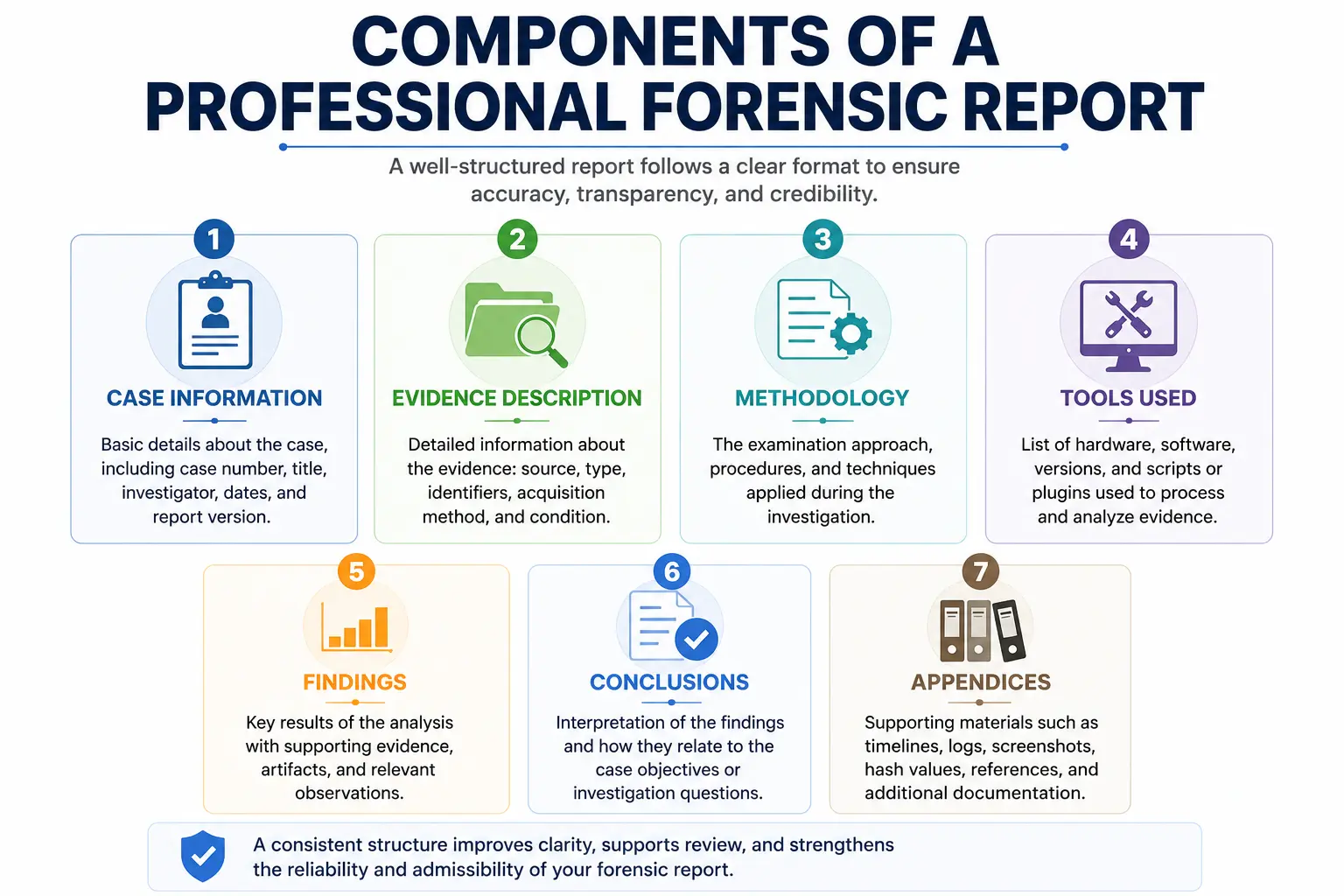
Core Components of a Professional Digital Forensic Report
While the exact forensic report format may vary depending on the investigation, most professional reports follow a similar structure to ensure clarity, consistency, and traceability.
Case Information Include basic case details such as the case ID, investigator name, reporting date, and investigation scope.
Evidence Description Document the evidence examined, including devices, storage media, accounts, or other relevant evidence sources.
Examination Methodology Describe how the evidence was acquired, analyzed, and validated. This section should clearly explain the procedures used during the investigation.
Tools and Environment List the forensic tools used, including their names, versions, and purpose within the examination process.
Findings Present the key evidence, artifacts, timelines, and other findings that support the investigation.
Conclusions Summarize the investigation outcome and explain how the findings support the final conclusions.
Appendices Include supporting materials such as screenshots, logs, reports, hash values, or other relevant documentation.
Together, these components form a clear and defensible forensic report structure, helping investigators communicate their findings accurately and consistently.
Engineer’s Note: The “Tools and Environment” section is often under-documented in practice — recording exact tool names and versions isn’t just good record-keeping, it’s what allows another examiner to understand exactly how a finding was produced if the report is ever challenged.
Step-by-Step Guide to Writing a Forensic Report
Step 1: Understand Reporting Principles
Before drafting a forensic report, investigators should understand the core principles that underpin professional forensic reporting. These principles help ensure that findings are reliable, defensible, and easy to understand.
The five key reporting principles are:
Objectivity– Present findings based on evidence rather than assumptions or personal opinions.
Accuracy– Ensure that evidence descriptions, timestamps, tool outputs, and conclusions are documented correctly.
Relevance– Include information that directly supports the investigation and its objectives.
Evidence Integrity– Document evidence handling and validation procedures to demonstrate that the evidence remained unchanged throughout the investigation.
Clear Communication– Present technical findings in a clear and structured manner so they can be understood by both technical and non-technical audiences.
By following these principles, investigators can produce reports that effectively communicate findings while maintaining professional and forensic standards.
Step 2: Define the Investigation Scope
Before documenting findings, investigators should clearly define the scope of the investigation. Establishing the scope helps ensure that the examination remains focused, relevant, and aligned with the objectives of the case.
Key elements to define include:
Investigation Objectives– Identify the purpose of the investigation and what needs to be determined or verified.
Questions to Answer– Outline the key questions the examination is intended to address, such as what happened, when it occurred, who was involved, and how the activity was carried out.
Evidence Sources– Determine which devices, accounts, storage media, cloud services, or other digital sources will be examined.
Clearly defining the investigation scope at the outset helps guide the forensic process and provides context for the findings presented later in the report.
Step 3: Document Evidence and Methodology
A forensic report should clearly document how evidence was collected, preserved, and examined. This section forms the foundation of the report, allowing other investigators, stakeholders, or legal professionals to understand how the findings were obtained and whether the process can be independently verified.
Key elements to document include:
Evidence Collection– Record the devices, storage media, accounts, cloud services, or other digital sources acquired during the investigation.
Chain of Custody– Maintain a detailed record of who handled the evidence, when it was accessed, and how it was transferred or stored throughout the investigation.
Acquisition Methods– Describe the techniques used to collect data while preserving evidence integrity.
Tools Used– List the forensic tools utilized during the examination, including their names, versions, and purpose.
Validation– Document any procedures used to verify evidence integrity, such as hash verification or forensic image validation.
When documenting the methodology, it is important to provide enough detail for others to understand and reproduce the examination process. For example, a computer investigation may involve creating a forensic image of a hard drive before analysis, while a mobile device investigation may use a logical or file system acquisition method depending on the device and investigation requirements.
Similarly, validation procedures should be recorded whenever possible. A common practice is to generate and verify hash values before and after data acquisition to confirm that the evidence remained unchanged throughout the process.
By thoroughly documenting both the evidence and the methodology, investigators can improve transparency, support reproducibility, and strengthen confidence in the report’s findings.
Engineer’s Note: When evidence involves damaged or partially recovered storage media, it’s worth explicitly noting in the methodology section whether a data recovery step (such as through DRS) preceded the forensic analysis — this distinction matters if the recovered data’s completeness is ever questioned later.
Step 4: Present Findings Clearly
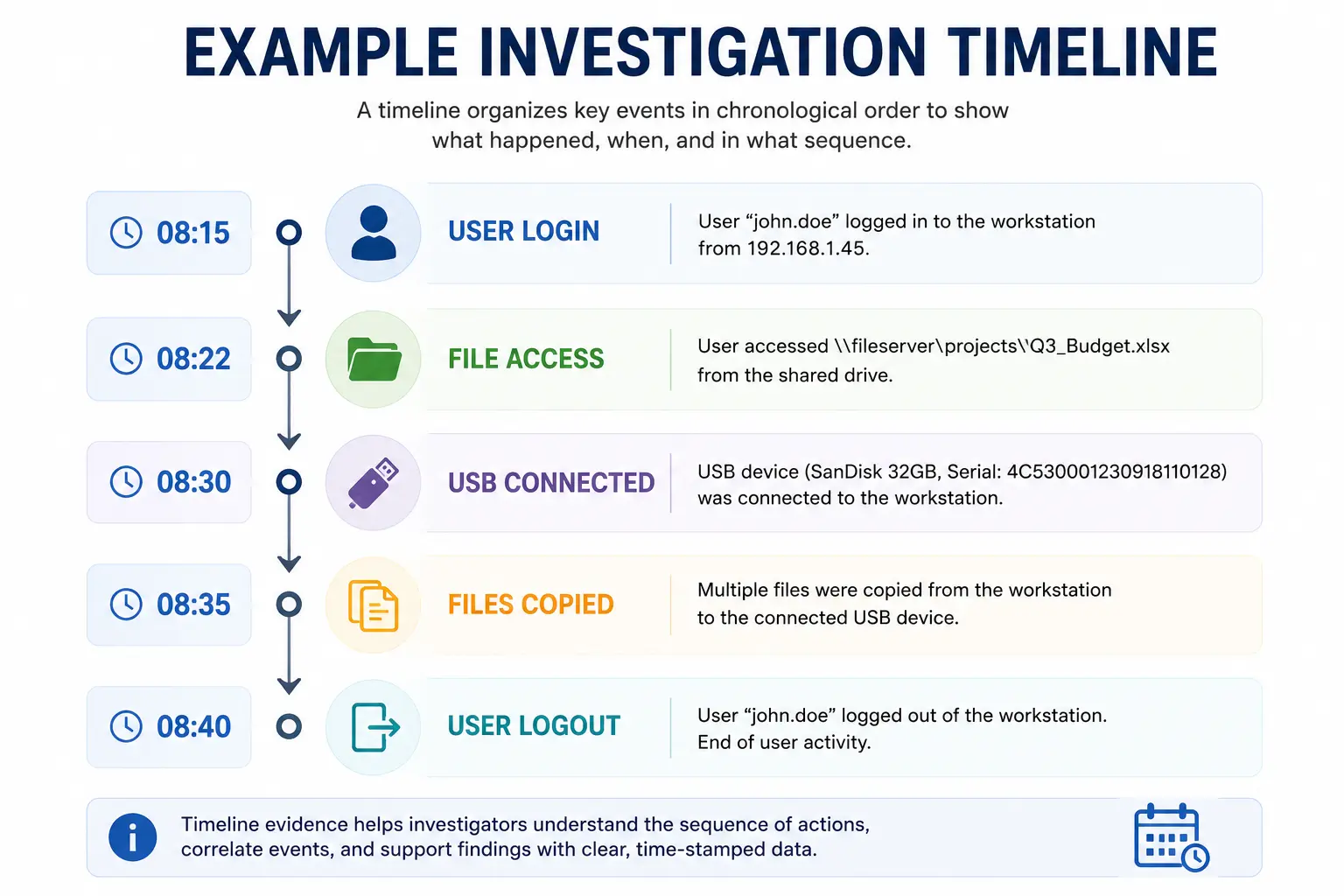
Example Investigation Timeline in a Digital Forensic Report
With the evidence collected and the methodology documented, the next step is to organize the report in a way that clearly communicates the investigation’s findings.
A typical report begins with a concise case summary that outlines the purpose and scope of the investigation. This section should provide enough context for readers to understand the case without overwhelming them with technical details.
The findings section should then present the evidence in a logical and structured manner. Key artifacts, records, and observations should be explained clearly, with each finding supported by relevant evidence. Where appropriate, include device details, timestamps, user activity, or other information that helps establish context.
To improve clarity, investigators often supplement their findings with:
Screenshots and exhibitsthat illustrate important evidence
Timelinesthat reconstruct events in chronological order
Figures and diagramsthat help explain complex relationships or activities
Appendicescontaining supporting materials such as logs, reports, hash values, or additional evidence
When describing the examination process, it is also helpful to identify the forensic tools used and explain their role in the investigation. This allows readers to better understand how the evidence was acquired, processed, and analyzed.
Most importantly, findings should be based on documented evidence rather than assumptions. Rather than speculating about intent or motivation, investigators should focus on what the available evidence demonstrates and how it supports the conclusions presented in the report.
A well-structured report enables investigators, legal professionals, management teams, and other stakeholders to follow the investigative process and understand how the final conclusions were reached.
Step 5: Review and Finalize the Report
Before submitting a forensic report, it is important to perform a thorough review to ensure the document is accurate, complete, and professionally presented. Even minor errors or inconsistencies can affect the credibility of the investigation and the reliability of its findings.
During the review process, investigators should verify:
Hash Values– Confirm that recorded hash values are accurate and match the original evidence or forensic images.
Evidence References– Ensure that all findings are properly linked to the supporting evidence, exhibits, or artifacts.
Methodology Documentation– Review the acquisition, examination, and analysis procedures to ensure they are clearly documented and reproducible.
Consistency– Check that dates, device identifiers, timelines, evidence references, and conclusions remain consistent throughout the report.
Grammar and Formatting– Correct spelling, grammar, and formatting issues to improve readability and professionalism.
In addition, investigators should verify evidence integrity by confirming that the evidence remained unchanged throughout the investigation. Any validation procedures, such as hash verification, should be reviewed and accurately documented.
It is equally important to review the chain of custody records to ensure that all evidence handling activities are properly documented. A complete and accurate chain of custody helps demonstrate accountability and supports the reliability of the investigation.
A carefully reviewed report not only improves accuracy but also strengthens confidence in the findings, making them easier for investigators, legal professionals, and other stakeholders to evaluate and verify.
Step 6: Present and Communicate Findings
The final step is to communicate the findings to the intended audience. Depending on the nature of the investigation, a forensic report may be reviewed by investigators, management teams, legal professionals, incident response personnel, auditors, or regulatory authorities.
Common use cases include:
Court Proceedings– Supporting legal actions with documented evidence and investigative findings.
Corporate Investigations– Assisting organizations in addressing employee misconduct, data theft, or policy violations.
Incident Response– Providing a record of security incidents, affected systems, and investigative conclusions.
Regulatory Reviews– Demonstrating compliance with industry regulations, internal policies, or audit requirements.
When presenting findings, focus on the evidence and the conclusions it supports. Technical details should be explained clearly, while key findings should be organized in a manner that allows both technical and non-technical audiences to follow the investigation.
Supporting materials such as timelines, screenshots, exhibits, and appendices can help clarify complex findings and improve the overall readability of the report. A clear and well-documented presentation ensures that stakeholders can understand the investigative process, evaluate the evidence, and make informed decisions based on the findings.
Digital Forensic Report Example Structure
Reviewing real-world forensic report examples can help investigators understand how evidence, methodologies, findings, and conclusions are documented in professional investigations. While report formats may vary depending on the case type and organizational requirements, most digital forensic reports follow a similar structure.
Case Information ↓ Evidence Description ↓ Examination Methodology ↓ Analysis ↓ Findings ↓ Conclusion ↓ Appendices
Each section serves a specific purpose, from documenting the evidence examined to explaining how conclusions were reached. Following a consistent structure helps improve clarity, transparency, and the overall quality of forensic reporting.
To see how these principles are applied in practice, consider reviewing the following examples:
Studying different types of forensic report samples can provide valuable insight into report organization, evidence presentation, and professional documentation practices. It can also help investigators understand how reporting requirements may vary across criminal investigations, corporate investigations, incident response engagements, and other forensic scenarios.
Common Mistakes in Forensic Report Writing
Even when an investigation is conducted properly, reporting mistakes can reduce the clarity, credibility, and usefulness of the findings. Understanding these common pitfalls can help investigators produce more professional and defensible reports.
Including Personal Opinions A forensic report should present facts supported by evidence, not personal beliefs or assumptions. Investigators should avoid speculative statements and focus on what the available evidence demonstrates. Conclusions should be based on documented findings rather than subjective interpretations.
Missing Methodology Details Failing to explain how evidence was acquired, preserved, or analyzed can make findings difficult to verify. A professional report should clearly document the examination process, including acquisition methods, analytical procedures, and any validation steps performed during the investigation.
Incomplete Evidence Documentation Every significant finding should be supported by relevant evidence. Missing screenshots, logs, timestamps, device information, or other supporting artifacts can weaken the report and make it harder for others to understand how conclusions were reached.
Failing to Verify Evidence Integrity Evidence integrity is a fundamental principle of digital forensics. Reports should document verification procedures, such as hash validation and chain of custody records, to demonstrate that the evidence remained unchanged throughout the investigation.
Overusing Technical Jargon Digital forensic reports are often reviewed by individuals with varying levels of technical expertise. Excessive use of technical terminology can make findings difficult to understand. When specialized terms are necessary, they should be explained clearly and used in a way that supports effective communication.
Avoiding these common mistakes can significantly improve the quality of a forensic report and help ensure that findings are accurate, transparent, and easy to evaluate.
Best Practices for Professional Forensic Reporting
Even when the technical investigation is conducted correctly, poor reporting can weaken the impact of the findings. Experienced investigators often follow a set of reporting practices that help improve clarity, support evidence-based conclusions, and make reports easier for others to review. The following tips can help elevate the professionalism and reliability of your forensic reports.
Use Consistent and Transparent Documentation
Consistency helps readers follow the investigation from start to finish. Evidence references, timestamps, device identifiers, and terminology should be documented in a standardized manner throughout the report.
If a device is identified as “Laptop-01” in the evidence section, the same naming convention should be used throughout the report to maintain consistency and avoid confusion.
Clearly Document Methodology and Tools Readers should be able to understand how evidence was acquired and analyzed. Reports should document the forensic methods used, the tools involved, and any relevant tool versions or validation procedures.
When browser activity is recovered from a forensic image, the report should clearly document how the image was acquired and which forensic tools were used during the examination.
Support Conclusions with Verifiable Evidence Every conclusion should be traceable to supporting evidence. Rather than making broad statements, investigators should reference the specific artifacts, logs, timestamps, screenshots, or records that support their findings.
For example, instead of stating that a user accessed confidential files, the report should reference the corresponding file access records, timestamps, and system artifacts that demonstrate the activity.
Engineer’s Note: A report that names its tools specifically — tends to hold up better under cross-examination or peer review, simply because it leaves less room for ambiguity about what was actually done.
Frequently Asked Questions About Forensic Reports
Q1: What is the difference between a forensic report and an investigation report? A: A forensic report focuses on digital evidence, examination methods, and forensic findings. An investigation report is broader and may include witness statements, case summaries, and operational findings. In many cases, the forensic report forms part of the overall investigation report.
Q2: How detailed should a forensic report be? A: A forensic report should include key details such as evidence sources, examination methods, forensic tools, relevant timestamps, and supporting artifacts. It should provide enough information for reviewers to understand how the findings were obtained and validated.
The goal is not to add detail for the sake of length, but to accurately document the forensic process and its findings. Information unrelated to the evidence, methodology, or conclusions should generally be excluded.
Q3: Should forensic reports include screenshots and supporting exhibits? A: In most cases, yes. Screenshots, logs, timelines, and other exhibits help support findings and make the report easier for stakeholders to review and understand.
Q4: How should an examiner document evidence that couldn’t be fully recovered?
A:State plainly what was attempted, what succeeded, and what remained inaccessible — an honest gap is far more defensible than a report that implies completeness it doesn’t have.
Q5: Should raw tool output, like hash logs or extraction logs, go in the report body or an appendix?
A: Reference them in the body, but keep the full raw output in appendices — this keeps the narrative readable while still making the underlying data auditable.
Q6: How should a report distinguish between what the evidence shows and the examiner’s interpretation? A: Keep them in clearly separate sections or clearly flagged sentences — conflating observed fact with inference is one of the fastest ways a report loses credibility under review.
Q7: How should timestamp discrepancies across time zones or devices be handled?
A: Normalize and clearly state the reference time zone used throughout the report, and note any known device clock drift — unexplained timestamp gaps are a common point of challenge.
Conclusion
A forensic report is more than a record of investigative activities—it is the document that connects evidence, methodology, and findings into a clear and understandable narrative. Whether the investigation involves cybercrime, corporate misconduct, incident response, or digital evidence recovery, the quality of the report can have a significant impact on how the findings are interpreted and acted upon.
By documenting evidence accurately, explaining methodologies transparently, and supporting conclusions with verifiable facts, investigators can produce reports that are both reliable and effective. A well-structured forensic report not only helps others understand what happened, but also provides assurance that the conclusions are supported by sound methodology and reliable evidence.