

What Is Privacy Coin? How It Works and Why It Matters in Digital Forensics

Knowledge
2026-04-08

Whats privacy coin?

Privacy coins are a category of cryptocurrencies specifically designed to enhance transaction privacy and user anonymity. Unlike standard cryptocurrencies, which often record transaction details on publicly accessible blockchains, privacy coins employ advanced cryptographic techniques to obscure key data such as sender and receiver identities, wallet addresses, and transaction amounts.

Common examples include Monero (XMR), Zcash (ZEC), and Dash (DASH). Findings from organizations such as Chainalysis and Europol indicate that these privacy features can significantly complicate traditional blockchain analysis.
Common Use Cases and Examples of Privacy Coins

Privacy coins are widely associated with high-risk scenarios due to their strong anonymity and resistance to tracing. Leading examples include:

  • Monero (XMR)– Default privacy using ring signatures and stealth addresses; highly resistant to tracing
  • Zcash (ZEC)– Uses zk-SNARKs for optional shielded transactions with strong privacy
  • Dash (DASH)– Applies CoinJoin-based mixing (PrivateSend); privacy depends on user usage

Illicit Use Cases

Dark Web Transactions
Privacy coins are widely used in dark web marketplaces, where anonymity is essential for both buyers and sellers. Compared to traditional cryptocurrencies, their enhanced privacy features make transaction flows significantly harder to trace, complicating investigative efforts.

Money Laundering and Ransomware Payments
They are often used to obscure illicit fund flows. In ransomware cases, attackers increasingly demand privacy coins to reduce traceability, as noted by Europol and Chainalysis.

Sanctions Evasion
Privacy coins can facilitate cross-border fund transfers with limited visibility, posing challenges for regulatory monitoring and enforcement.

Key Technical Features of Privacy Coins

Privacy coins are built on specialized cryptographic mechanisms designed to enhance transaction privacy and reduce traceability:

  • Anonymity:Hides the identities of senders and receivers using techniques such as ring signatures and zero-knowledge proofs.
  • Untraceability:Prevents transactions from being linked on the blockchain, making fund flows difficult to follow.
  • Confidentiality:Conceals sensitive transaction details, including amounts and wallet balances.
  • Fungibility:Ensures that all units of the currency are interchangeable, without being affected by past transaction history.

These features collectively differentiate privacy coins at a technical level, making them resistant to conventional blockchain analysis.

Anonymity vs Pseudonymity in Blockchain

The distinction between privacy coins and traditional cryptocurrencies is best understood through the concepts of anonymity and pseudonymity, which reflect their underlying design principles:

  • Pseudonymity (traditional cryptocurrencies):Transactions are recorded on transparent public ledgers, where users are identified by wallet addresses. While these addresses do not directly reveal real-world identities, transaction patterns and external data sources can often be used to establish links between addresses and individuals.
  • Anonymity (privacy coins):Transactions are structured to obscure both participant identities and transaction details. Advanced cryptographic techniques are used to prevent reliable tracing or linkage, significantly reducing data visibility on the blockchain.

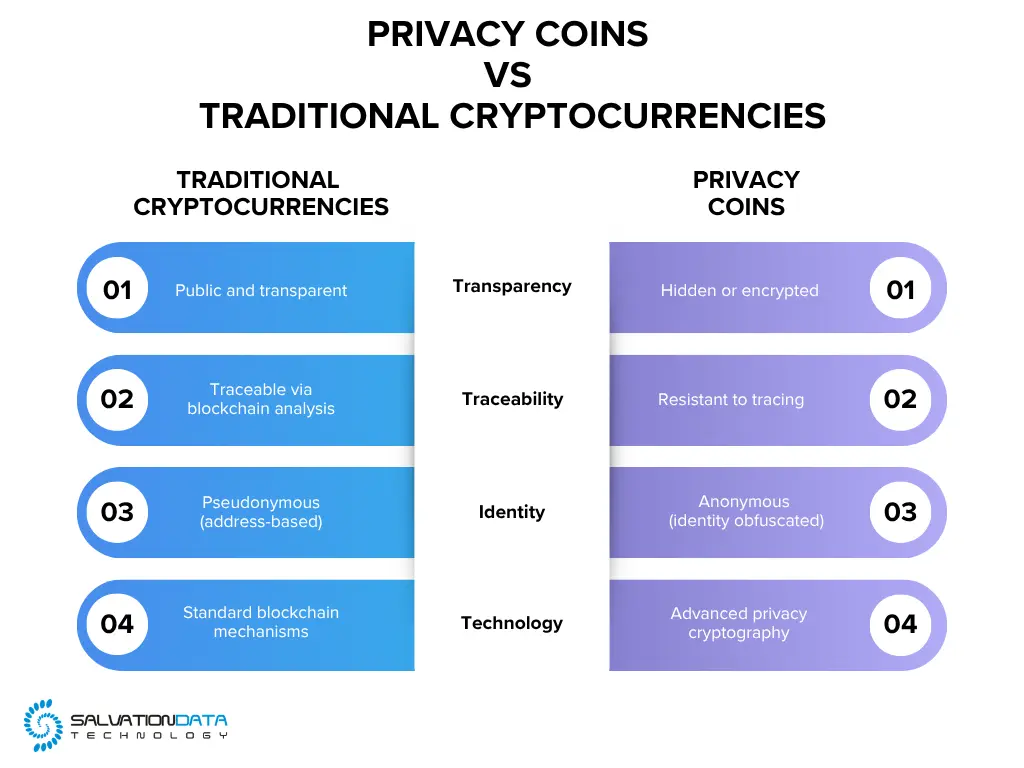
Cryptocurrencies comparison: Privacy Coins vs Traditional Cryptocurrencies

Crypotecurrency Comparison: Privacy Coins V.S. Traditional Crypotecurrencies

From a technical and investigative perspective, this difference leads to clear contrasts:

  • Data transparency:Public and fully accessible vs selectively hidden or encrypted.
  • Traceability:Transactions can be traced through analysis vs intentionally resistant to tracing.
  • Analytical approach:Blockchain-based tracing vs reliance on external or off-chain data.

How Privacy Coins Work: A Forensic Perspective

Privacy coins use advanced cryptographic techniques to obscure transaction data and disrupt the traceability of public blockchains, hiding details such as identities, amounts, and wallet linkages.

From a forensic perspective, this significantly limits traditional methods like transaction graphing and address clustering. As visibility decreases, investigators must rely more on indirect approaches, including off-chain data correlation and device-level evidence.

Key Technical Features of Privacy Coins

  • Ring Signatures– Obscure the sender by mixing their transaction with others, as used in Monero.
  • zk-SNARKs (Zero-Knowledge Proofs)– Verify transactions without revealing sender, receiver, or amount (used in Zcash).
  • Coin Mixing / CoinJoin– Combine multiple transactions to obscure original fund sources and destinations (used in Dash).

Can Privacy Coins Be Traced?

Privacy coins are specifically designed to resist tracing, creating significant challenges for blockchain analysis. Traditional analytics rely on transparent ledgers to map transactions and link addresses, but the cryptographic mechanisms behind privacy coins—such as ring signatures, stealth addresses, zk-SNARKs, and coin mixing—obscure critical details, making full reconstruction of transaction flows extremely difficult.

While some investigative methods can provide partial insights, they often depend on off-chain data such as exchange records, network logs, and wallet metadata. These indirect traces can offer clues but rarely reveal the complete picture of on-chain activity.

Challenges for Digital Forensics and Law Enforcement

  • Transaction Tracing Limitations:On-chain data is intentionally obfuscated, reducing the effectiveness of traditional blockchain analytics. 、
  • Increasing Use in Cybercrime:Privacy coins are increasingly leveraged for ransomware, dark web marketplaces, and sanctions evasion, raising the stakes for law enforcement.
  • Dependence on Off-Chain Evidence:Investigators must rely on exchange records, network logs, and other external data sda’dources to track illicit activity.
  • Importance of Device-Level Forensics:Wallet files, local transaction histories, and system artifacts become crucial sources of evidence when blockchain visibility is limited.

Investigators must rely on off-chain data, network logs, and device-level evidence to partially reconstruct transactions hidden by privacy coins. While anonymity cannot be fully overcome, these methods provide key insights for tracing illicit activity and supporting regulatory or law enforcement efforts.

The Future of Privacy Coins and Digital Forensics

Privacy coins are expected to grow in adoption due to demand for financial privacy and censorship resistance. As their use expands, both legitimate and illicit transactions will increasingly challenge blockchain analysis and forensic investigations, with evolving privacy protocols making tracing more complex.

Digital forensics will need to focus on off-chain evidence, device-level data, and advanced analytics to keep pace. Understanding the technical mechanisms behind privacy coins is essential for effectively analyzing activity on these networks.

In summary, privacy coins enhance user privacy but also pose significant challenges for digital forensics and regulatory compliance, requiring innovative investigative approaches to manage the associated risks.